

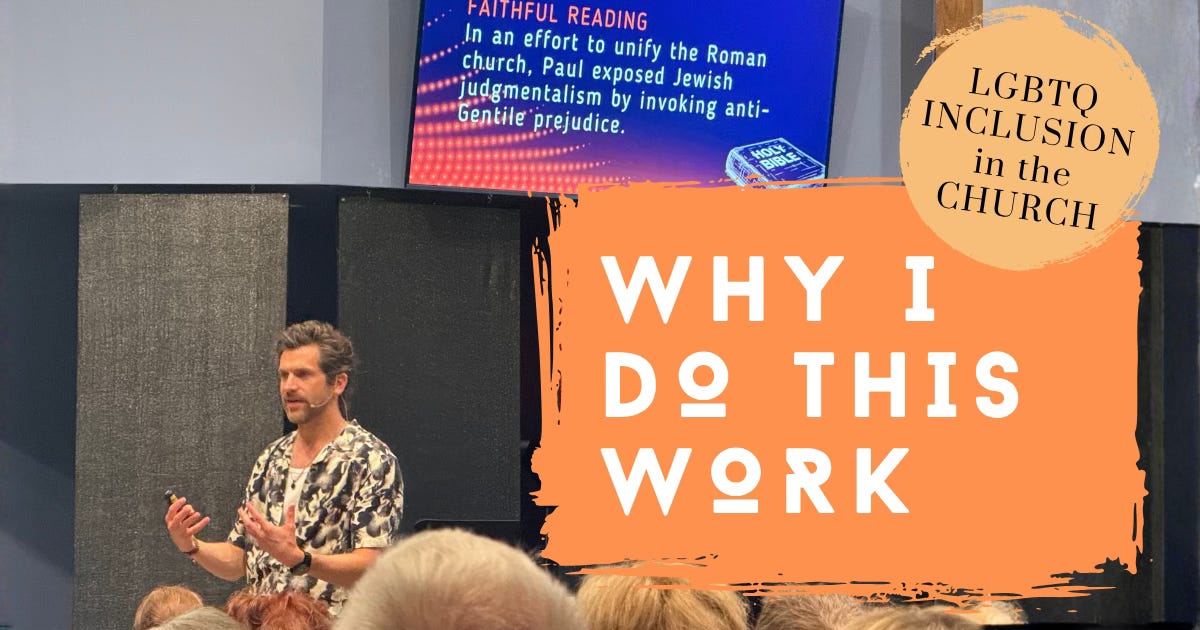
There are a handful of questions that pop up with a high degree of regularity when I travel.
One of the most frequently asked questions is,
“Colby, why do you do this?”
The “this” in question is in reference to my work with The UnClobber Initiative—which is to say, my now 15+ years of trying to educate and resource people with better beliefs around LGBTQ inclusion in the church.
It’s a good question, and most folks who ask it do so with added qualifiers of, “Why, as a straight, cis, white man do you do this work?”
The implicit assumption is often: Why do something that doesn’t directly benefit you?
For starters, I’d suggest that “doing things that don’t directly benefit you, but instead benefit others” is kind of a hallmark of being Christian. You know, the whole…
“Blessed are the peacemakers” (Matt 5:9)
“Whatever you do for the least of these you do for me” (Matt 25:40)
“It is more blessed to give than receive” (Acts 20:35)
…that kind of thing.
But then there’s also a point to be made about how advocating for the full inclusion of LGBTQ people in the church (as well as society) actually does benefit me. Raising the tide of human flourishing lifts the boats of all people. You know, the whole…
“Injustice anywhere is a threat to justice everywhere” (MLK Jr)
“Nobody’s free until everybody’s free” (Fannie Lou Hamer)
“If you have come here to help me, you are wasting your time. But if you have come because your liberation is bound up with mine, then let us work together” (Lilla Watson)
… that kind of thing.
Besides, as a follower of Jesus I have chosen to opt in to a worldview that sees all of humanity as being connected. We are all one body, therefore, in the words of Paul, “If one member suffers, all the members suffer with it, and if one member is honored, all the members celebrate with it.” (1 Corinthians 12:26)
So I suppose it is enough to answer the question, Why do I do this work, by merely saying: Advocating for the liberation and well-being of those in our society who suffer as a result of intolerance and religiously motivated bigotry is the Christ-like thing to do.
That, to me, feels like the bare minimum. The starting point. The kind of reasoning that I both gladly accept and also cannot see any argument against.
However, for me, it also goes deeper than that.
I also do this work because, well, first a quick story from the Gospel of Luke. Found in chapter 18, this story also shows up in Matthew and Mark but I prefer the Lukan version for a reason I’ll explain in a minute.
The story starts,
35 As Jesus came to Jericho, a certain blind man was sitting beside the road begging.
36 When the man heard the crowd passing by, he asked what was happening.
37 They told him, “Jesus the Nazarene is passing by.”
38 The blind man shouted, “Jesus, Son of David, show me mercy.”
You may well know that being blind in that day and age would’ve been a tough gig. Not only was society not setup at all to accommodate those without vision, but there also existed an added layer of some people believing that such a state was divine retribution for sin. This blind man, then, was not only destined for a life of roadside begging, but he likely carried with him the shame draped upon him by a community who assumed he deserved what he got.
Sitting beside the road, forced to ask others to explain life to him, was a picture of this man’s larger state of being. Namely, that of an Outsider.
And to make matters worse, he would’ve been deemed ritually unclean by his physical condition. Unfit to take part in religious community. It’s no stretch to suggest this man was pitied at best and outright shunned at worst.
Which explains what happens next.
39 Those leading the procession scolded him, telling him to be quiet,
In Mark’s account of this story we read that Jesus was traveling with his disciples. So when Luke describes “those leading the procession,” I’m assuming and imagining he’s referring to said disciples.
Whether it was the actual twelve or not is beside the point. Rather, it is enough to hear that there were those out front, leading the way, traveling with Jesus, seeking to be disciples of their rabbi, who were the ones that turned to the blindman on the side of the road and… did what? Welcomed him? Helped him stand? Walked him over to Jesus? Hollered at Jesus to hold up a second?
Nope.
They scolded him. Shushed him.
Here was a man who had the audacity to try and cross the (totally arbitrary and utterly dehumanizing) boundaries of who’s in/who’s out, who’s clean/who’s unclean, who’s good/who’s bad.
And the disciples, the leaders of the movement, were not having it.
Shush, man. We have places to go and important things to do. Our Teacher doesn’t have time for you. You’re being a nuisance. A distraction.
In other words, you’re there for a reason, so stay there.
But this time it was the man who wasn’t having it. So,
39 … he shouted even louder, “Son of David, show me mercy.”
This time his shouting worked. He caught Jesus’ ear.
40 Jesus stopped…
Now, I like to think at this point in the story Jesus had a couple options available to him. Upon hearing a man across the way shouting at him:
Jesus could have walked over to him and asked, “Yes? What would you like?” But he didn’t do that.
Jesus could have turned around and hollered across the crowd, “YES, MY MAN? WHAT CAN I DO FOR YOU?” But he didn’t do that.
I supposed Jesus even could have bent over, spit in the dirt, and made one of his famous Sight Restoring Mudballs (John 9:6). Then flung it threw the air like Patrick Mahomes, perfectly splashing the man’s face for a healing mud mask. But he didn’t do that.
No, what Jesus did next (at least according to the Lukan account, which is why I prefer it) captures the essence of why I do what I do.
40 Jesus stopped and called for the man to be brought to him.
Did you catch it?
After hearing the cries of the blind man Jesus stops, turns to the very people who just moments ago shushed the blind man, and he tells them, “bring the man to me.”
The one you just rebuked? Go get him.
The one you just tried to keep quiet? Go get him.
The one you attempted to keep in his place as an outsider? Yeah, go get him and bring him to me.
To the men who just moments ago had been responsible for reinforcing the socio-religious boundaries of in/out, good/bad, us/them, Jesus charged the task to undo it all.
That wall you just built to keep that person out? Go tear it down.
As it was back then, so it is today. Because take one guess as to who have been the responsible parties for all the efforts over all the years to keep LGBTQ people on the outside? Who have been the policy makers, the theology creators, the boundary enforcers? Who have built the walls that have decisively and with piercing clarity told LGBTQ people that they are unclean and do not have the same access to Jesus as the rest of us do?
Yeah, people like me: Straight, cis, men.
It has been people like me (and in my early years in ministry, actually me) who have “shushed” and “rebuked” those on the margins seeking equal access to the mercy of Christ.
So why do I what I do?
Because many years ago, while reading this exact story from Luke 18, I heard Spirit’s voice loud and clear: Go get them and bring them to me.
I have been a part of and been complicit in systems that have for far too long sought to dehumanize and discriminate against those who identify as LGBTQ. And even though I’ve repented of such sins years ago, it will take more than my lifetime to counter the centuries of oppression.
Yet my lifetime is all I have to give, and so I give it.
Therefore,
to the extent that I can help tear down the walls of separation,
to the extent that I can expose the toxicity of non-affirming theology,
to the extent that I can get the message out to as many people as possible that we are all God’s beloved children just as we are,
I will keep doing this work as best as I know how.
That’s why I do this.
p.s. If you’re curious about some of the other most asked questions I get about LGBTQ inclusion, the Bible, and faith, consider pre-ordering my next book, But What About. It responds to loads of them :)
p.p.s. If you’d like to learn more about The UnClobber Initiative, and how you can help partner in the work of making churches safer for LGBTQ people, go here.
Amen, brother! It is impossible to undo all the wrongs that have been committed in Christ's name, but is incumbent upon insiders to do as much as we can.
Thanks for writing this and for the work that you are doing from the inside to open people’s minds and help erase the unnecessary boundaries that humans erect.