

Most Christians1 still believe that being gay is a sin, same-sex relationships cannot be blessed by God, and any suggestion that your gender identity is mismatched with your biological sex is a problem needing solved.
In short, the fully affirming and LGBTQ inclusive position within Christianity remains the minority. That was true ten years ago when I wrote UnClobber and—though the affirming position has seen enormous growth in the past decade—it is still the case today.
Which is why I’m not done talking about it nor done writing about it. Perhaps I’ll stop banging this drum when we’ve hit the point where 51% of churches in America fully welcome, accept, and affirm LGBTQ people, but since we’re not even at double digits yet, the harvest is still more than plentiful.
Ergo, I hope my next book, But What About: The Most Asked Questions on Faith, the Bible, and LGBTQ Inclusion will become as helpful a resource as UnClobber has been in terms of demonstrating how the fully affirming position is not a departure of our Christian faith but is, in fact, its truest expression.2
To make that case, I spent the last few years compiling some of the questions that have been most frequently asked at my live events and workshops, or sent through my website and DMs. Because here’s what I’ve learned after doing this work for more than a decade: while UnClobber helped thousands of people sort through the six clobber passages on their way to full inclusion, other people have reasonable follow-up questions.
And those questions often begin with the setup: But what about…?
Hence the title of my book, and hence the project to further advocate for the unquestioning belovedness of all people.
But What About doesn’t release for another few weeks (but you can pre-order it today from Amazon, Barnes & Noble, Target, Powells, and others here), so I figured I’d give you a taste of what’s to come.
Therefore, down below is an excerpt from Chapter 2 titled, But What About the Bible?
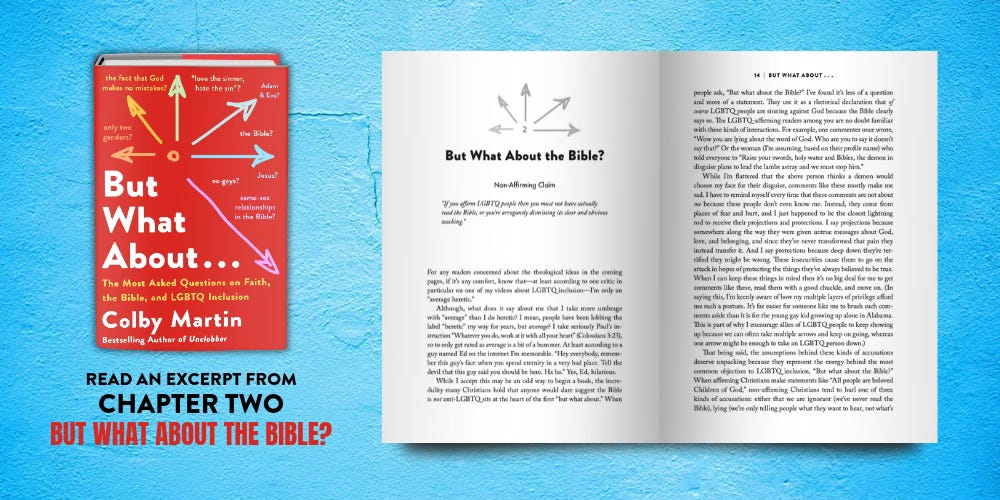
Enjoy.
-Colby
CHAPTER 2
But What About the Bible?
Non-Affirming Claim:
“If you affirm LGBTQ people then you must have not actually read the Bible, or, you’re arrogantly dismissing its clear and obvious teaching.”
For any readers concerned about the theological ideas in the coming pages, if it’s any comfort then know that—at least according to @qenzio1545 on one of my videos about LGBTQ inclusion—I’m only an “average heretic.”
Although, what does it say about me that I take more umbrage with “average” than I do heretic? I mean, people have been lobbing the label “heretic” my way for years, but average? I take seriously Paul’s instruction, “Whatever you do, work at it with all your heart,” (Colossians 3:23), so to only get rated as average is a bit of a bummer. At least according to @edbaird7687 I’m memorable. “Hey everybody, remember this guy’s face when you spend eternity in a very bad place. Tell the devil that this guy said you should be here. Ha ha.” Yes, Ed, hilarious.
While I accept this may be an odd way to begin a book, the incredulity many Christians hold that anyone would dare suggest the Bible is not anti-LGBTQ sits at the heart of the first “But What About.” When people ask, But what about the Bible, I’ve found it’s less of a question and more of a statement. They use it as a rhetorical declaration that of course LGBTQ people are sinning against God because the Bible clearly says so. The LGBTQ affirming readers among you are no doubt familiar with these kinds of interactions. For example, @carolinavenzor8502 once wrote, “Wow you are lying about the word of God. Who are you to say it doesn’t say that?” Then there’s @MartyrMaria who told everyone to, “Raise your swords, holy water and Bibles, the demon in disguise plans to lead the lambs astray and we must stop him.”
While I’m flattered that Martyr Maria thinks a demon would choose my face for their disguise, comments like these mostly make me sad. I have to remind myself every time that these comments are not about me because these people don’t even know me. Instead, they come from places of fear and hurt, and I just happened to be the closest lightning rod to receive their projections and protections. I say projections because somewhere along the way they were given untrue messages about God, love, and belonging, and since they’ve never transformed that pain they instead transfer it. And I say protections because deep down they’re terrified they might be wrong. These insecurities cause them to go on the attack in hopes of protecting the things they’ve always believed to be true. When I can keep these things in mind then it’s no big deal for me to get comments like these, read them with a good chuckle, and move on. (In saying this, I’m keenly aware of how my multiple layers of privilege afford me such a posture. It’s far easier for someone like me to brush such comments aside than it is for the young gay kid growing up alone in Alabama. This is part of why I encourage allies of LGBTQ people to keep showing up because we can often times take multiple arrows and keep on going, whereas one arrow might be enough to take an LGBTQ person down.)
That being said, the assumptions behind these kinds of accusations deserve unpacking because they represent the energy behind the most common objection to LGBTQ inclusion, “But what about the Bible?” When affirming Christians make statements like “All people are beloved Children of God,” non-affirming Christians tend to hurl one of three kinds of accusations: either that we are ignorant (we’ve never read the Bible), lying (we’re only telling people what they want to hear, not what’s true), or arrogant (we think we’re superior to God). So let’s address these misconceptions.
Have You Not Read?
Many Christians see the full affirmation of LGBTQ people as absurd. Not because they’re heartless, but because as far as they see it the Bible is clear and obvious: homosexuality is a sin, same sex relationships are outside God’s design, and all humans are only ever one of two genders based on their biological sex. The clarity of Scripture seems so blinding that they’re left to assume people like myself just haven’t read the Bible otherwise we’d also see the obvious. In the words of @sreed7637, “Clearly you haven’t read 1 Corinthians 6:9. Let me help you with a few more verses for understanding: Leviticus 18:22 and Romans 1:26-27.”
In my more charitable moments I can understand this perspective. If all one does is a quick Google search for the Bible and homosexuality, and if the extent of one’s research starts and stops at reading a modern English translation of the text, then I suppose it’s not unreasonable to read, “Do not have sexual relations with a man as one does with a woman; that is detestable” (Lev 18:22, NIV) and declare the matter settled. But just because I understand it doesn’t mean I think it’s valid. On the contrary, it’s actually quite ridiculous to think that LGBTQ affirming Christians haven’t read their Bible.
None of us arrived at our positions without having taken seriously the Bible’s most often used verses on the topic. In fact I’d wager that on average the typical affirming Christian has engaged the clobber passages by orders of magnitude more than those out there who are copy/pasting Romans 1:26-27 in random people’s comment sections. The other day I read a meme saying something to the effect of, Fun Fact: LGBTQ Christians spend years studying Greek and learning to exegete Scripture all so we can be told by strangers online that we’ve never read our Bibles. I feel the frustration behind that sentiment deeply.
The bottom line is, Christians who have changed their heart and mind to become affirming of LGBTQ people have come by our convictions honestly. Accusing the affirming position of being ignorant is deeply inaccurate and desperate. In fact, the irony is that behind many of the allegations of those who call affirming Christians “ignorant” is, well, some genuine ignorance. Allow me to explain.

Book Launch Events in SAN DIEGO, PORTLAND, and DENVER
I’ve got three Book Signing & Launch events coming up. Hope to see you there!

San Diego | Nov 18 at 7:30pm
Warwick’s Books
RSVP Here
Portland | Dec 2 at 7pm
Powells City of Books
INFO Here
Denver | Dec 14 at 6pm
Tattered Cover
TICKETS Here
I’m speaking of “most Christians” in my own context, America. Of course the “most” gets even most-ier when you zoom out to a Global perspective because Christianity in the global south and across Africa is even more theologically conservative on this topic than we are here in the States.
This usage of “Not X but Y” construction is entirely my own and not the product of AI. Reminder: AI was trained on us, the writers. I was using em dashes and negative parallelism long before the LLMs tried sounding like us. I shan’t relinquish them easily.