
I walk a fine line writing about LGBTQ inclusion as a straight, cisgender, male pastor.
It isn’t always obvious when and where and how to steward my layers of privilege.
Ten years ago when I wrote UnClobber I was still pretty green when it came to understanding various identities and intersectionality, and I had a lot to learn about what it meant to be a guy like me doing this kind of work. I’m still learning, to be sure. Sometimes I’m able to check myself before I wreck myself, but other times I must do said checking after the wrecking.
I know I haven’t always walked this line well, but I’ve made a commitment to continue walking it even though it’s a risk (it would be easier, I suppose, to just not try and write or talk about LGBTQ inclusion, and use the excuse of “I’m staying in my lane” as some sort of cover). Because for me the greater risk is if people like me (straight, cis allies) stay out of the fray altogether simply because we’re afraid of doing it wrong or messing it up.
Nah, this work (the work of inclusion and equality) is far too herculean to not be taken up by any and every body, utilizing all manner of approaches, tactics, and efforts.
All that to say, when I outlined the topics I wanted to cover in my next book I knew I wanted… needed… to dedicate space to writing about gender and gender identity. Like I said the other day, the scope for UnClobber was pretty narrow (e.g., only the six clobber passages), so that book didn’t really get into any particular aspects of the transgender topic. But a lot has changed in ten years, including the rise of all things trans.
So even though I know I won’t do it perfectly, I used chapter four in But What About to respond to the question, “But what about God not making mistakes with gender?”
And actually, doing or not-doing it “perfectly” is a perfect setup, because that’s what a good chunk of the chapter is about. What perfection is/isn’t; how the ancient Greeks thought about the word; and how that impacts the way we read and interpret Scripture.
There are many dimensions to the LGBTQ inclusion conversation, and many paths one might take to become fully affirming. With this chapter I hope I’ve offered a path that feels both fresh and compelling. While I cannot speak to what it is like to be transgender (which is why I rely heavily in this chapter on my trans friends and their experiences and expertise), I hope I can help people think through this particular topic in a new way.
Enjoy.
-Colby
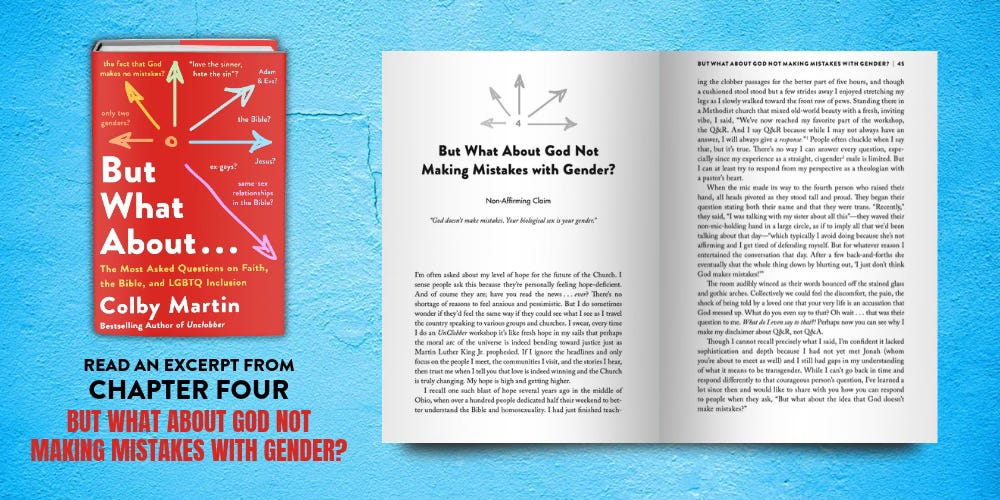
p.s. If you haven’t already, make sure to pre-order But What About on Amazon, Barnes & Noble, Target, Powells, or other options here.
p.p.s. If you missed it, I previously shared excerpts from
Chapter 2 (But What About the Bible?), and
Chapter 3 (But What About Adam & Eve?)
CHAPTER 4
But What About God Not Making Mistakes with Gender?
Non-Affirming Claim:
“God doesn’t make mistakes. Your biological sex is your gender.”
I’m often asked about my level of hope for the future of the church.
I sense people ask this because they’re personally feeling hope deficient. And of course they are, have you read the news… ever? There’s no shortage of reasons to feel anxious and pessimistic. But I do sometimes wonder if they’d feel the same way if they could see what I see as I travel the country speaking to various groups and churches. I swear, every time I do an UnClobber Workshop it’s like fresh hope in my sail that perhaps the moral arc of the universe is indeed bending toward justice just as MLK Jr prophesied. If I ignore the headlines and only focus on the people I meet, the communities I visit, and the stories I hear, then trust me when I tell you that love is indeed winning and the church is truly changing. My hope is high and getting higher.
I recall one such blast of hope several years ago in the middle of Ohio, when over 100 people dedicated half their weekend to better understand the Bible and homosexuality. I had just finished teaching the clobber passages for the better part of five hours, and though a cushioned stool stood but a few strides away I enjoyed stretching my legs as I slowly walked toward the front row of pews. Standing there in a Presbyterian church that mixed old-world beauty with a fresh, inviting vibe, I said, “We’ve now reached my favorite part of the workshop, the Q&R. And I say Q&R because while I may not always have an answer, I will always give a response.” People often chuckle when I say that, but it’s true. There’s no way I can answer every question, especially since my experience as a straight, cisgender male is limited. But I can at least try and respond from my perspective as a theologian with a pastor’s heart.
When the mic made its way to the fourth person who raised their hand, all heads pivoted as they stood tall and proud. They began their question stating both their name and that they are trans. “Recently,” they said, “I was talking with my sister about all this,” they waved their non mic-holding hand in a large circle, as if to imply all that we’d been talking about that day, “which typically I avoid doing because she’s not affirming and I get tired of defending myself. But for whatever reason I entertained the conversation that day. After a few back and forths she eventually shut the whole thing down by blurting out, ‘I just don’t think God makes mistakes!’”
The room audibly winced as their words bounced off the stained glass and gothic arches. Collectively we could feel the discomfort, the pain, the shock of being told by a loved one that your very life is an accusation that God messed up. What do you even say to that? Oh wait… that was their question to me. What do I even say that?! Perhaps now you can see why I make my disclaimer about Q&R, not Q&A.
Though I cannot recall precisely what I said, I’m confident it lacked sophistication and depth because I had not yet met Jonah (whom you’re about to meet as well) and I still had gaps in my understanding of what it means to be transgender. While I can’t go back in time and respond differently to that courageous person’s question, I’ve learned a lot since then and would like to share with you how you can respond to people when they ask, “But what about the idea that God doesn’t make mistakes?”
Conflating Transgender with Gender Dysphoria
I met Jonah on a hot, sticky, sweaty afternoon at The Wild Goose Festival. And if you’ve ever been to The Wild Goose Festival then you know that “hot, sticky, and sweaty” are unnecessary qualifiers for “afternoon.” It is assumed.
Jonah is a queer, trans pastor and community organizer from Milwaukee and over the last several years they have taught me a lot about the transgender experience. Of course like all identity groups, transgender people are not a monolith. If you’ve met ten trans people, then you’ve met ten trans experiences and perspectives. It’s both impossible and unwise to refer to the trans experience as a universal one, but at the same time there is enough overlap in the trans community that it behooves us cisgender folk to be aware. To learn. To listen.
One evening last year I sat at my desk reflecting on some news I’d just received that someone I love had recently made the courageous choice to identify as transgender. While I’ve spent years and countless hours studying and reflecting on matters of homosexuality and the Bible, the same couldn’t yet be said on transgender topics. I knew basic information, and I certainly had deep and meaningful relationships with a number of trans people, but when my loved one came out as trans I knew I needed to increase my database of resources. Not just for myself but also in the event I could be of help to either them and/or others in their lives who might soon be looking to better understand what was happening. So I texted Jonah and asked if they had a suggestion for a book that would be like a Transgender 101, so I could become more educated about trans people’s experiences.
“Hey Jonah, what’s your go-to recommendation to help people learn about gender dysphoria and the experience of trans people?” I sent via Messages. If this term is unfamiliar to you, gender dysphoria is the name of the diagnosis given by professionals to define the deep discomfort a person can feel when who they know themselves to be on the inside (ie, their deeply felt sense of gender identity) does not match the body they were born with (ie, their biological sex) nor the way the world sees them, which is usually based on culturally developed gendered stereotypes. In 2013 gender dysphoria was added to the DSM-5, however—and this is key—not because being transgender is a disorder, but because the intense psychological and emotional pain that sometimes accompanies the experience of being transgender often requires medical, psychological, and social support.
One of my earliest forays into understanding the experience of gender dysphoria came years ago from my friend Paula Stone Williams. Paula is a transwoman author, pastor, and wildly successful TED speaker. She’s also one of the smartest and most grounded people I know, utterly confident and secure in who she is. Yet that wasn’t always her story. In her memoir, As a Woman: What I Learned about Power, Sex, and the Patriarchy after I Transitioned, Paula reflects on the distress she experienced for decades living as a man (the biology of her birth) all the while knowing—since before she could even spell her name—that she was a girl. But her world had no place for her, no category for her narrative, and specifically (since she was raised in and thrived in the evangelical world) no theological allowance for her existence. While as a man, Paula outwardly experienced a successful life by all conceivable metrics (family, children, fame, industry respect, and so on), inwardly she suffered year after year. For Paula, living out of alignment with her true self was torturous. She experienced the distress and depression of dysphoria, and for years viewed it as something to fight and try to triumph over. I imagine that her journey, unique though it is to her, mirrors many who identify as transgender insofar as it relates to the pain and the suffering endured while living out of gender identity alignment.
Since Paula is one of my closest and longest running friends-who-are-also-trans, and because her story shares commonalties with many other trans people’s stories, I inadvertently developed the assumption that all transgender experience is rooted in dysphoria. What I had yet to learn was that just because a person identifies as transgender does not therefore mean they also experience and/or suffer from the associated dysphoria. My text exchange with Jonah revealed both my conflation as well as the gaps in my knowledge.
After replying back with a helpful link for a Transgender 101 type website, Jonah then sent the following, “Honestly, I wouldn’t start with dysphoria. If that’s what’s coming up for people, I totally get it and it’s worth responding to. But to the extent that you can lead people into deeper understanding of transness, there are other places to go. In general, trans people have led with dysphoria because we often feel backed into a corner—as though we must justify our existence through our suffering. But there’s also conversations to be had about gender euphoria, gender bending, and in general the experience of holding an identity that experiences the world fundamentally differently than cis people (and not for the worse).”
Woah. Okay. I think I may have responded with the mind-blown emoji, or at least that’s what I remember feeling. What an exceptional and (what I wish would have been more) obvious observation. This is part of what I alluded to in Chapter 1 when I talked about how my relationships with LGBTQ people are imperative because these aren’t things I experience directly. I’m constantly learning and listening and adapting as best as I know how. And Jonah was absolutely right, of course not all trans people experience dysphoria. I mistakenly thought “dysphoria” served as synonym for “mismatched,” implying that to be transgender was to experience gender dysphoria. But in its clinical usage dysphoria is not about the state of being, it’s the distress felt within that state.
An imperfect analogy might be motion sickness. The other day I rode an old school Whirl-a-Twirl carnival ride with my 13 year old. Now, when I was 13, or 23, or sheesh even 33, I could’ve whirl’d and twirl’d many times with great delight. But 43?! Good gravy, as soon as the ride began my panic began. For about 30 solid seconds—which felt like an eternity—I was convinced that my corndog from five minutes earlier was fixing to reemerge. So while my son and I were experiencing the same thing, our experience of that experience was as diametric as it gets. To borrow from Jonah’s text, my son was experiencing ride euphoria, whereas I was in immediate need of psychological and emotional support due to suffering from ride dysphoria.

Book Launch Events in SAN DIEGO, PORTLAND, and DENVER
I’ve got three Book Signing & Launch events coming up. Hope to see you there!
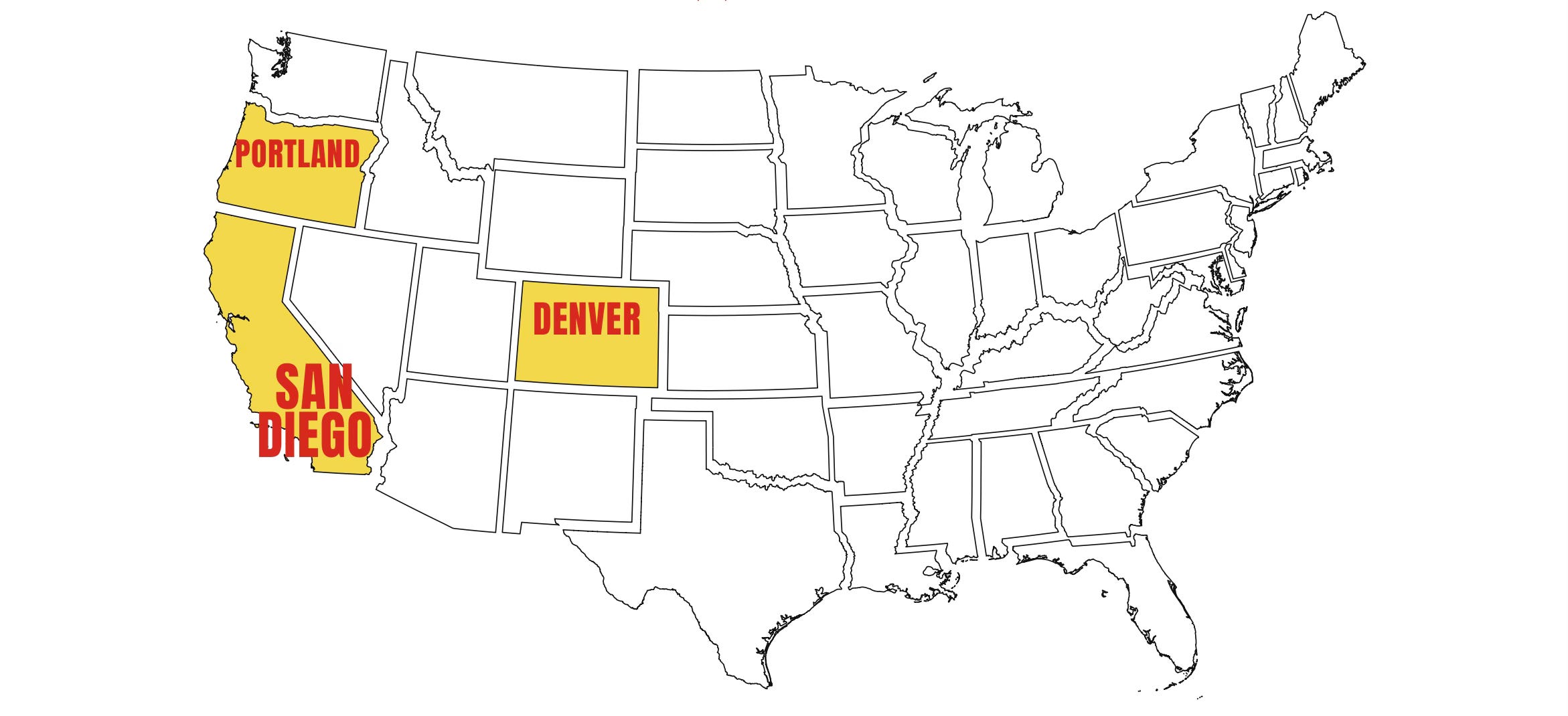
San Diego | Nov 18 at 7:30pm
Warwick’s Books
RSVP Here
Portland | Dec 2 at 7pm
Powells City of Books
INFO Here
Denver | Dec 14 at 6pm
Tattered Cover
TICKETS Here