

15 years ago I added my voice to the ever growing choir of scholars, theologians, and run of the mill Bible readers who have discovered what is hidden in plain sight:
The notoriously wicked ancient cities of Sodom and Gomorrah were not destroyed because of homosexuality.
Why were they destroyed, then?
I’ve spent the aforementioned past 15 years trying to teach on precisely that. And for as much as I’ve written about it, created online content about it, and travelled the country to teach it, I’m not sure I’ve been near as effective as Christopher Nolan’s latest masterpiece, The Odyssey.
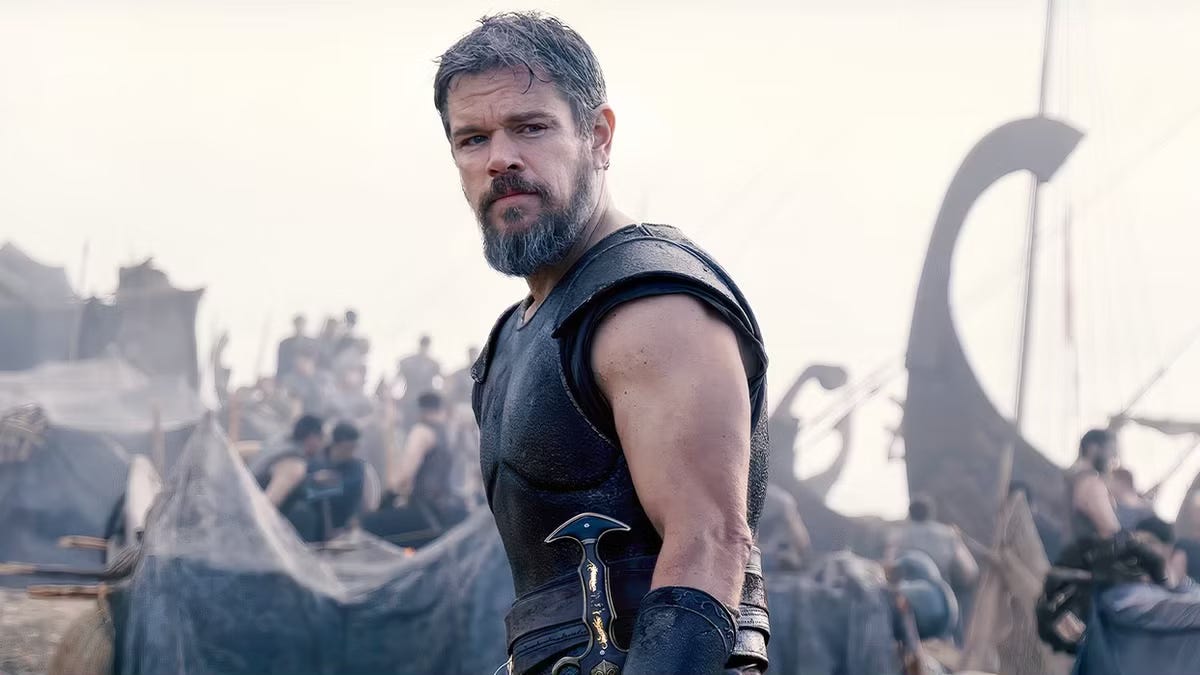
Yep, that’s right. I submit to you that Nolan’s three-hour blockbuster based on the most legendary Epic of all time may actually be all that a person would need to watch in order to understand the ancient Jewish story found in Genesis 19—the very one that many Christians have erroneously believed (and continue to believe) is a story about God’s judgment of homosexuality.
I’ve now seen the film twice. In fact this is the first time I’ve ever gone to a theater on back to back nights to watch a movie. I love it. For so many reasons. But today I just keep thinking about how The Odyssey perfectly illustrates why the ancient Jewish people told the story of Sodom and Gomorrah.
Allow me to explain.
First, I’ll briefly share why Sodom and Gomorrah were not destroyed due to homosexuality. This should be obvious by now. Then I’ll offer takeaways from The Odyssey and what I felt was its biggest idea (spoilers for the film, btw. I know the story is 3,000 years old, but some of Nolan’s authorial adaptations are unique, and I’ll be spoiling them.) Finally, I’ll show why I think this movie perfectly captures and explains the legend of Sodom and Gomorrah.
The Destruction of Sodom and Gomorrah
In case you need it, here’s a quick primer/reminder on the story found in Genesis 19.
The ancient cities of Sodom and Gomorrah were the worst. Things had gotten so bad God was ready to wipe them out. However, Abraham is able to convince God to stay His hand of judgment if there are at least ten innocent people in the city. God agrees, then sends two “messengers” (ie, angels/heavenly/divine beings disguised as regular joes) to investigate. They arrive at Sodom late in the evening and are met by Abraham’s nephew, Lot, who was on gate duty. Since Lot had lived in Sodom for quite some time he knew the dangers awaiting these two visitors and proceeds to convince them to stay at his place for the night. Sure enough, after Lot makes a wonderful meal and as they prepare to retire, all the city’s men storm Lot’s home and bang on the door. “Where are those men from out of town? Bring them out to us so that we can have sex with them!” Lot intervenes, begs them to turn away. In fact, he is so committed to protecting his guests that he offers the mob his daughters instead. The men decline, for they are there for the strangers, the outsiders, the out-of-towners. Enraged, the mob try to force their way inside. The Messengers rescue Lot and tell him to take his family and get the heck out of dodge. Lot, his wife, and their two daughters escape to the nearby city of Zoar just as the sun rises on a new day—the final day for Sodom and Gomorrah. Burning asphalt rains from the skies as God metes out judgment on two cities who were so far gone that not even ten decent folk could be found. The end.
As I said, 15 years ago when I studied this story in earnest for the first time, I came to the unavoidable conclusion that this story has nothing to do with homosexuality, and nothing to do with the question of whether or not God (or the Bible, or the ancient Jewish people) were against the idea of two people of the same sex being in a loving, mutual consenting relationship.
And once you see it, it’s impossible to unsee it.
Even now if I do my best to try and read Genesis 19 with the lens of, “The reason these cities were wicked was because the men were gay” I just cannot get there. It’s absurd.
Consider just the following two details:
The storyteller repeatedly emphasizes that “all the men of the city” surrounded Lot’s home. There’s no statistical possibility for “all the men of the city” to be gay.
The mob was hell bent on forcing themselves on the outsiders. At stake was what we’d now call gang rape—horrific and rightly worthy of judgment. Not at stake? The matter of a mutually consenting relationship between people of the same sex.
That alone is sufficient to understand that Genesis 19 isn’t about homosexuality as an orientation (the men in the story are not gay), nor is it about the morality of same-sex relationships. To that point, if the story has any intention to condemn sexual behavior, the only rational conclusion is a condemnation of trying to force yourself on to another person (to say nothing of the group aspect of it all).
But then the case against the idea that Sodom and Gomorrah were destroyed over homosexuality grows even stronger when you see how other, later Biblical writers talked about the legend of S&G’s destruction.
Two examples:
The prophet Jeremiah connected the failures of the prophets during his time to that of the wickedness of Sodom and Gomorrah. “In the prophets of Jerusalem I saw something horrible: They commit adultery and tell lies. They encourage evildoers so that no one turns from their wickedness. In my eyes, they are no better than Sodom; its people are like Gomorrah.” (Jeremiah 23:14)
Then Ezekiel flat out wrote, “This is the sin of your sister Sodom: She and her daughters were proud, had plenty to eat, and enjoyed peace and prosperity; but she didn’t help the poor and the needy. They became haughty and did detestable things in front of me, and I turned away from them as soon as I saw it.” (Ezekiel 16:49-50)
None of the later Biblical writers connect Sodom and Gomorrah with something like homosexuality or same-sex relationships.
I hope the point is made.
Sodom and Gomorrah is not, was not, and ought not be thought of as a story condemning homosexuality.
So what was it about?
Time to talk about Nolan and The Odyssey.
It’s All About Zeus’ Law
From the opening scene to the movie’s climax, one particular thread held the multiple timeliness and perspectives together: the importance of Zeus’ Law.
For the ancient Greeks, Zeus’ Law was their North Star of morality. It set them apart from other civilizations and, importantly, it enabled them to build one of the greatest Empires.
So what was Zeus’ Law?
It was a code of hospitality. If a stranger shows up at your door or on your island then you were required to provide shelter and food.
Their built-in culture of, and commitment to, hospitality allowed the Greeks to travel far and wide because they knew they’d be taken care of. It also fostered deep trust between groups and families that otherwise might be at war.
Zeus’ Law established a foundation, a safety net of basic needs, to ensure all people—especially strangers—would be taken care of.
On top of that sat a theological layer as well, which The Odyssey made plain multiple times. The movie pointed out that we ought always ensure a stranger is tended to because that stranger might very well be a god in disguise.
Zeus’ Law worked because it had both a compelling carrot and stick. The carrot: providing hospitality for strangers is beneficial to all. The stick: you might be entertaining a god, so beware.
This fundamental posture animated ancient Greece in ways that spread all throughout the known the world. They even had a word for it: xenia, which literally means, “guest friendship. (BTW, that’s where we get our word xenophobia from, which means the fear of the Other.) If you’ve seen the film, then you recall just how deeply Telemachus and Penelope (Odysseus’ son and wife) held fast to Zeus’ Law, even though it put their own well-being at risk.
I’d put it like this: Extending hospitality—especially to outsiders, beggars, and strangers—is the backbone of civilization. As long as we care for one another, and as long as we care for those who are not-like-us and who are in need, we will be okay. But should we fail to do this?
That’s one of the questions the movie explores.
The Failure to Uphold Hospitality
Before he left for war and joined Agamemnon’s army to attack Troy, Odysseus cherished and embodied Zeus’ Law. His commitment to xenia, to showing hospitality, illustrated the bedrock of his own family’s value structure, yes, but it was also a picture of the entirety of the Greek people’s civilization.
That is why Odysseus’ abandonment of Zeus’ Law was so consequential. He pulled the rug out from under everything.
In one of the best scenes of the movie, Odysseus (disguised as a beggar) has an extended conversation with his wife, Penelope, in which he confesses the guilt he’d been carrying since the war. As it turns out, Odysseus’ most famous move, the singular idea that won him fame and won the battle against Troy, had become the source of his deepest shame: the Trojan Horse.
This great deception took Zeus’ Law and didn’t just set it aside as wartime inconvenience, no, in order for the Trojan Horse to work it had to fully rely on and lean in to the heart of Zeus’ Law, all so that it could be turned on its head.
Like in Akido, the Japanese martial arts that uses the momentum of an attacker against them, the Trojan Horse pretended to be a gift that one could safely bring in to your home—only once inside, instead of exuding hospitality, the “gift” exerts horror.
In earlier parts of the film when we see the sacking of Troy (e.g., when Menelaus tells the story to Telemachus), you find yourself rooting for Odysseus and others. After a 10 year campaign of suffering on the beach, they finally get their victory!
But when Odysseus recounts his own telling of that fateful night to Penelope? We see the same battle on screen, but this time we watch as women and children are slaughtered and buildings are razed to the ground. It’s not a victory to cheer as much as it’s an execution to look away from. It’s the kind of hunting that Odysseus shuns earlier in the film, when you have such an advantage over your prey that’s it not even fair. It’s why he plucks his bow, to at least give the animal a chance.
The people of Troy had no chance. And it was Odysseus’ plan that took it from them.
To make the point crystal clear, in the final viewing of the defeat of Troy we watch as the men grab, hold, and (thankfully not shown) behead a young girl. And it is in that moment when you realize who the girl was: Athena in disguise.
The total undoing of Zeus’ Law was complete.
And from that moment on, from the burning of Troy and the inversion of xenia, we are told about the domino falling collapse of civilization.
All movie long the audience is told about the terrifying prospect of the coming of the People from the Sea, barbarian marauders who arrive on boats to rape and pillage. But we never actually see them. Why?
Because the brilliant gut-punch of Nolan’s vision is that it was those who left the shores of Troy victorious who were in fact the Sea People. The terrifying invaders who Penelope and others feared were in actuality the men who followed her husband.
So what was the central failure of Odysseus and his men?
What led to the collapse of civilization?
The abandonment of Zeus’ Law.
The neglect of xenia.
The choice of violence and domination instead of hospitality and care.
Which takes us back to Sodom and Gomorrah.
The Real Sin of Sodom
I can feel the air in the room deflate a bit whenever I stand on a stage and say, “The reason Sodom and Gomorrah got destroyed was because of hospitality, not homosexuality.”
It sounds so thin. Hospitality? Really?!
I try to explain how hospitality in the ancient world was held in much higher esteem than it is today, and how it encompassed far more than what we think of nowadays. We might hear “hospitality” today and think of mints on a pillow, snacks for party guests, and playing smooth jazz in the background so everyone vibes nicely.
But hospitality in the ancient world was about so much more than that, and it meant so much more than that. It was, in short, the metric by which your morality was measured. If you showed hospitality to outsiders (aka, xenia, aka, Zeus’ Law) then you would be well thought of. If you refused—or worse, if you took advantage of outsiders, or harmed them in some way—then your reputation as wicked would spread.
With that (and with The Odyssey) in mind, read again how Ezekiel described the “sin of Sodom.”
“This is the sin of your sister Sodom: She and her daughters were proud, had plenty to eat, and enjoyed peace and prosperity; but she didn’t help the poor and the needy. They became haughty and did detestable things in front of me, and I turned away from them as soon as I saw it.” (Ezekiel 16:49-50)
Those ancient cities had the provisions, they had the food and the wine, they had the shelter and the safety… but instead of helping the poor and needy, they dragged them into the streets and abused them.
Even Jesus had something to say about the virtue of hospitality.
In Matthew 10 he sends out his disciples to go village to village announcing the Kingdom of Heaven. They were to rely on the hospitality of others, and when they received hospitality they were instructed to stay and bless the home. But to the homes that rejected them? Those who failed to practice xenia?
“If anyone refuses to welcome you or listen to your words, shake the dust off your feet as you leave that house or city. I assure you that it will be more bearable for the land of Sodom and Gomorrah on Judgment Day than it will be for that city.”(Matthew 10:14-15)
I hope the point is clear. The Jewish tradition behind the wickedness of Sodom and Gomorrah came down to their failure to show hospitality. And that is why God (in the story, that is) destroyed them.
I know that sounds harsh. Extreme. And your’e not wrong.
But for that time, for that culture, for that era, it was that serious. And that seriousness is what The Odyssey conveyed so brilliantly.
Christopher Nolan’s bold suggestion that the very balance of a civilization hinges on whether or not its people embody hospitality is, in my opinion, the perfect encapsulation of why the story of Sodom and Gomorrah was told at campfire after campfire, for generation after generation, and finally got preserved as one of the founding stories of the Abrahamic faith.
The Bible teaches us that for Yahweh, for the God of Abraham, Isaac, and Jacob, the care of the outsider was crucial It was central to what it means to be good. Or, in a much more basic sense, it is part and partial of what it means to be human.
And when we lose track of that?
When we oppress the other instead of care for them,
when we reject the outsider instead of welcome them,
when we plunder our neighbors instead of provide for them,
when we demonize those who are different instead of searching for their humanity,
then we become like Sodom.
We become Gomorrah.
We are the Sea People who’ve completely lost track of the Way.
Perhaps judgment is an appropriate response.
Have You Seen it Yet?
I’d love to know your thoughts/experience with seeing The Odyssey.
What stood out to you? How did it make you feel? What did you walk away with (if anything)?
POST-SCRIPT-EDIT
Interested in understanding more about the Bible and homosexuality? Including my full thoughts on Genesis 19 (Sodom and Gomorrah)?
My first book, UnClobber: Rethinking Our Misuse of the Bible and Homosexuality is available wherever books are sold.

And my follow up to UnClobber is set to release November 17, which you can pre-order now. But What About: The Most Asked Questions on Faith, the Bible, and LGBTQ Inclusion

So compelling, Colby! (I always love when another Colby has great ideas.) I think this idea is especially important in the context of declining community and neighborly trust in the US. We need this willingness to take in and care for other people. We need the ability to open ourselves up to the inconvenience and messiness of connecting with a stranger and outsider simply because they are here. It seems like our whole society is built around isolation and separation, not hospitality and unity. And our lives are less happy because of it!
I am interested in why I those who write/speak on this topic never mention Judges 19. It seems to me that it is a parallel account of Sodom and Gomorrah, but with the concubine of the Levite. It helps explain the importance of hospitality.