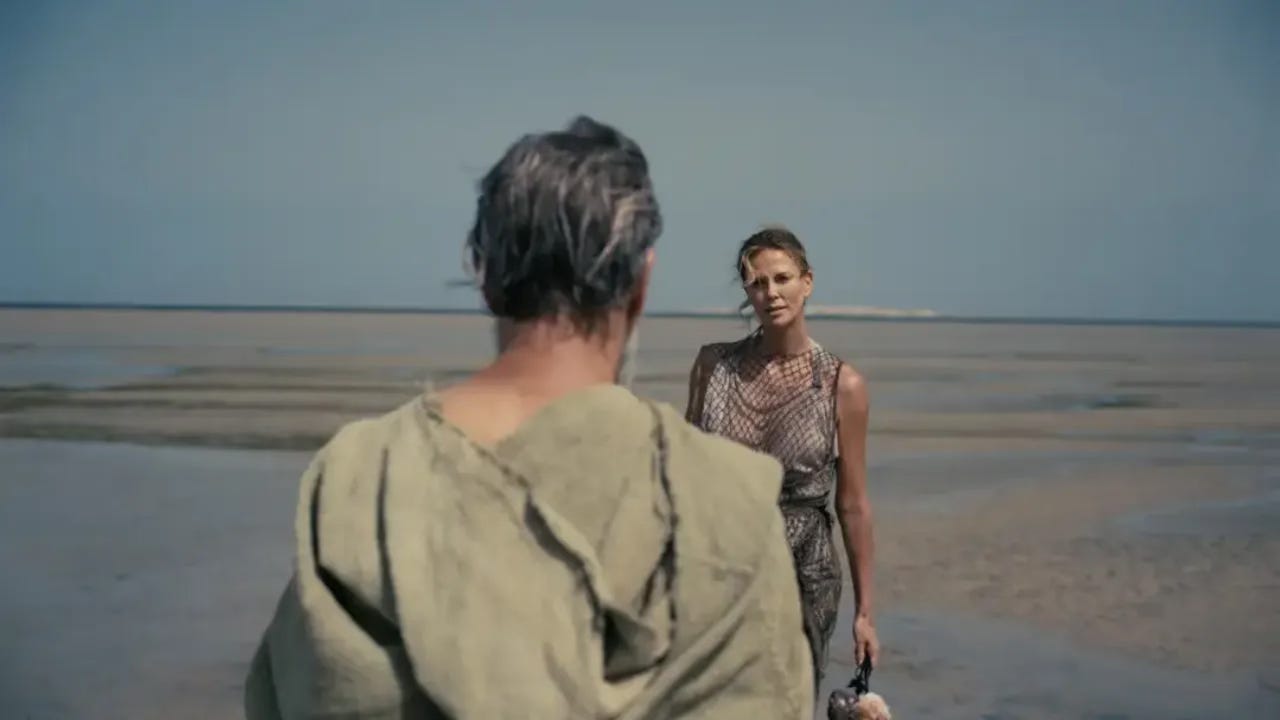
When Odysseus Found Salvation in The Odyssey
Two moments in Christopher Nolan's "The Odyssey" stood out to me, both having to do with the concept of Salvation.
Two of the most moving scenes for me in Christopher Nolan’s The Odyssey had to do with… well… hold that thought.
First,
a quick detour through a Greek word;
some thoughts on an unfortunate translation in the Bible;
my opinion on a serious misconception within Christian theology;
stuff about/from Jesus…
And then we’ll come back to The Odyssey.
What’s in (an Old Greek) Word?
For my money, one of the great misconceptions in Christian theology arises out of choices made in how to interpret this one specific ancient Greek word.
Of course, the blame cannot solely be laid at the feet of translation—as though, if we just found a better word then all would be well… probably not—yet the way this word gets translated in English certainly hasn’t done this particular theological misconception any favors.
I’m referring to the Greek word, σῴζω (sózó).
If you look up sózó in any Greek concordance you’ll get some version of:
to save, to keep safe and sound, to rescue or deliver from danger or destruction.
That’s pretty straightforward for the most part. (Although, note that sózó can be used literally or metaphorically. You need the context to grasp how best to read it.)
But there’s another dimension to sózó beyond the saving/rescuing/delivering component, which is when sózó conveys:
to heal; to be made whole.
Sure, I can see how there’s an immediate and obvious connection between English words like “save/rescue” with “heal/wholeness,” but there are also meaningful differences. Differences we ignore at our own peril. Specifically because (and this goes back to my point above about how an unfortunate English translation has contributed to a theological misconception) when we hear the word “saved” in today’s world, especially in a religious context, our minds almost immediately go to “life after death.”
Yet what comes to mind when you hear the word “heal?”
Or, “be made whole?”
Exactly.
You’re thinking of the here-and-now.
You don’t take antibiotics to be fixed after you die, you take them to help heal you now. You don’t go to a therapist to work on your mental well-being for after you kick the bucket, you seek to find emotional and psychological wholeness for this life, the one you’re actually living.
Therein lies the dilemma.
While we may know (kinda) what sózó meant two thousand years ago, how do we try and translate/adapt it for our world today?
The Dilemma of Interpretation
Translators face two distinct problems when thinking through which English word (or words) best capture sózó.
First: in what sense (literal or metaphorical)? Second: in what time (now or post-death)?
To the first question, is sózó being used literally:
“sózó us Lord, we are perishing!” Mt 8:25. In this case the disciples were freaking out in a boat during a storm happening in that moment. They desired actual saving/rescuing/sózó’ing.
Or is sózó being used metaphorically:
“whoever would sózó his life will lose it, but whoever loses his life for my sake will find it” Mt 16:25. It seems clear Jesus wasn’t literally talking about dying and not-dying.
Settling the literal-vs-metaphorical usage of sózó isn’t all that complicated. The context generally makes it clear.
Where it gets murky is when scholars and translators try to work out whether or not sózó is being used to refer to life here and now or life in the thereafter.
My hot take?
I’m not sure we should ever read sózó and think it is pointing to life after death.
At least not in the Synoptic Gospels of Matthew, Mark, and Luke (see footnote for one possible exception).1 In the Synoptics every single time sózó shows up it is clearly in reference to something happening here and now. Whether a rescuing or a healing, whether literal or metaphorical, the action and the expectation is always for an experience of life now.
I will add that John’s Gospel is a bit different in how it uses sózó, and requires a bit more attention. For example, if all you knew about the life of Jesus came from John, and if you were taught (or even just assumed) that John was written-as and intended-to-be a literal, historical account of the life of Jesus, then translating sózó as “saved” and thinking in terms of “life after death” is reasonable. For example:
For God did not send his Son into the world to condemn the world, but in order that the world might be saved through him. -John 3:17
I am the door. If anyone enters by me, he will be saved and will go in and out and find pasture. -John 10:9
If anyone hears my words and does not keep them, I do not judge him; for I did not come to judge the world but to save the world. -John 12:47
If someone wants to read those verses and think that John was using sózó to mean an experience or event that happens after death, I’d understand.
I’d only ask them if they’ve considered that John was written much later than the Synoptics (so likely isn’t as reliable in terms of quoting Jesus accurately); and that John was written with a different purpose than the Synoptics (meaning, it’s much more concerned with theology, philosophy, and ideas… not so much historicity or biography).
Point being: the usage of sózó in John might be more of a reflection of later church theological imagination than an attempt to do the same thing that sózó is doing in Matthew/Mark/Luke.
All that to say,
if sózó in the Gospels was never used by Jesus to mean “something that happens after death,” then that leads to…
A Misconception in Christian Theology?
Interpreting sózó as “saved” in English (at least most of the time, as is the case) has quite possibly contributed to the ongoing assumption/belief that to be saved is about what happens when we die.
And I think that is the great misconception.
I suggest that instead of being an event or experience of the afterlife, salvation is a process in this life.
And if that is true (or at least true enough) then what might happen if, instead of translating sózó as “saved”—which conjures ideas of afterlife in our Western, American, modern ears—we read sózó as healing and wholeness? Which are perfectly legitimate meanings for sózó, it’s just that translators don’t use them that often.
Or suppose the context does indeed have a “rescue/deliver” connotation to it, then I still suggest we keep it in the frame of the here-and-now.
Because of course we can be delivered from things that prevent us from wholeness now.
What it Means to be Saved
Look, I know this may sound wild to people.
After all, most of us have been conditioned to think of Christianity as a religion about Heaven and Hell.
Most people, whether in the church or out, have internalized the idea (through explicit teaching or even just implicit cultural artifacts and media) that “salvation” is about what happens when we die. So having someone (as I’m doing here) suggest otherwise sounds… well… absurd. And wrong. And ignorant.
And maybe I am. I don’t know.
But when I look at what sózó meant in its original context (the Greek world), and when I look at how Jesus used the word over and over again (specifically in the Synoptic Gospels), I don’t think it’s outlandish to say that sózó was (and therefore is still) intended to be about life here and now.
Perhaps salvation—if that’s the word we decide to stick with—is best thought of as the ongoing process or project of being made whole.
Perhaps salvation is the healing of our fractured parts.
Perhaps salvation is the rescue and deliverance from the choices, the factors, the elements, the systems, the people, and the stories that disintegrate us.
Put simply, Salvation is the re-membering of our brokenness. It is the coming back home to our unified self.
Okay… NOW we are ready to talk about The Odyssey.
Odysseus’s Salvation
Let me be clear: I do not think that Christopher Nolan was attempting to tell a Christian story with The Odyssey. Nor do I think that he was trying to smuggle in Christian themes. In my article last week about how The Odyssey helps us to better understand why Sodom and Gomorrah were destroyed in Genesis 19, multiple people made comments under the false impression that I was somehow suggesting that The Odyssey was about Genesis 19.
No, no, and nope.
That being said, as someone who to tries to be Christian, and as somehow who views the world through a particular set of Christian-flavored lenses, it’s only natural for me to, at times, see Christian ideas/values/principles in the art I consume. I won’t apologize for that.
So if a reader cannot see the difference between doing that (which I am doing) and making a claim that The Odyssey is a Christian movie, or is about the Bible in any way (which I am not doing), then I don’t know what to tell you. Moving on…
This article began with me saying, “Two of the most moving scenes for me in Christopher Nolan’s The Odyssey had to do with…” allow me to finish that thought:
The two scenes that moved me most were both about Odysseus’ salvation.
And hopefully with all the work I did to tell you what I mean by “salvation,” the following will make more sense.
Salvation Moment #1: When Odysseus finally surrendered, let go, and trusted.
After being drugged by Calypso for seven years and kept in a fugue state where he didn’t remember who he was, how long he’d been there, or that he had an identity and a family beyond the island, Odysseus was mercifully given a way out by Calypso. She slowed down her feeding him of the lotus plant and allowed him to regain his memories.
But when the final moment came, and Odysseus hit the point where he not only remembered his wife and son but he also wanted to go home to them, only one option was before him. Only one path if he truly wanted to go home.
After years of defying the gods,
after years of going his own way,
after years of trying to control the uncontrollable and avoid the unavoidable,
Calypso says this to him:
You're a man who needs to control his fate. But you cannot control this.
You must give yourself to the storm, give yourself to Poseidon. And take your punishment.
Give up the fight, give up control and live.
It is a leap of faith you haven't yet made, Odysseus.
Odysseus tried many different things to get home and they all ended in abject failure. Worse, they ended with the deaths of his entire crew.
The one thing he hadn’t tried?
Letting go. Giving up control.
I loved Nolan’s choice to illustrate this by having Odysseus build the weakest and meekest raft ever (he should’ve had Moana build it for him). And once upon this rickety, barely floating contraption, Odysseus basically assumes the savasana yoga pose—the ultimate posture of letting go. Of release.
Of… in a word… trust.
And against all his prior beliefs about the way the world works, against all his assumptions about how one ought approach teh world, against all his decades of conditioning to function one certain way (ie, be in control), Odysseus discovers the liberating truth that one can never fully know until they experience it… that we find our rescue when we release control.
For Odysseus, finally letting go and choosing to trust (in Poseidon) instead of himself was, for him, a moment of salvation.
Put another way: If we want to find our life, first we must be willing to lose it.
Salvation Moment #2: When Odysseus Named His Deepest Shame
Miraculously (or, maybe not… maybe, predictably) the letting go worked and Odysseus made it home.
But his project of wholeness-making (aka, salvation) was still in process. It’s almost as though he made a kind of vertical reconciliation (with the gods) but needed still to make a horizontal reconciliation (with humanity).2
One of my top three favorite scenes from the movie is Odysseus-as-beggar sitting on the stoop of his wife/queen Penelope telling her about the Trojan War. That moment is, I’d suggest, Christopher Nolan’s single greatest contribution to the 3000 year old project of reading/adapting Homer’s The Odyssey.
He took Odysseus’ greatest triumph and turned it into his deepest shame.
As I wrote here, when Odysseus describes the sacking of Troy to Penelope we, the audience, finally understand why Odysseus dragged his feet for 20 years to return home. He was crushed under the weight of shame, realizing that his idea (the Trojan Horse) was not just a complete abandonment of his commitment to Zeus’ Law, but it was a move of such deception that it led to a night of slaughter and destruction the likes of which no human soul can endure.
While Odysseus watched women and children be slaughtered in Troy, the weight—not just of war, but of the utter abandonment of what it means to be human—undid him.
Civilization began its unravelling that night, and Odysseus felt like he’d pulled the first thread.
Any person who has ever made a choice—especially one that represents the exact opposite of what you’ve always stood for—and watched as it results not just in suffering for others and yourself, but in the shattering of worlds (literally and/or metaphorically), can relate to what Odysseus must’ve felt.
And that level of intense, deep shame caused a rupture inside of Odysseus. He split. His soul rent in at least two, if not more.
But he found sózó,
he found rescue,
he found wholeness and healing,
when he stopped running from his mistakes. When he came home: literally to Ithaca, and metaphorically to himSelf.
Admitting to himself and to his wife that he did wrong—by the gods, by the people of the world, by his own Self—was truly a salvific moment for Odysseus.
One exception to this might be Mark 16:16 where Jesus, after the resurrection, tells his disciples, “Whoever believes and is baptized will be sózó’d, but whoever doesn’t believe will be condemned.” It’s not unreasonable to read that as a statement about the after-life, but here’s the thing: scholars almost universally agree that that verse is part of an ending of Mark that was added much later—like, a hundred years later. And if that’s the case, then we should at least consider the possibility that using sózó in that way reflects a later Christian idea (about heaven/hell) that wasn’t original to the Gospel itself, and certainly wasn’t how Jesus talked or thought.
I’m not sure I love this framing, it’s a bit reductive, the whole horizontal/vertical, humanity/gods thing. But I’m keeping it in for lack of a better framing at the moment. Just know that I know that it’s imperfect :)


When I saw Odysseus on the raft, it reminded me of when I changed my name 30 years ago. I ran naked into the sea at dawn (overcoming my fear of shark feeding at that time) and I lay in outstretched pose floating and giving myself up to God's plan for me. I saw myself from way above, just drifting like a little toothpick on the surface of the world. An insignificant drifter. It was an incredible moment for me and the power of it all has stayed with me. Thank you for reminding me of the vows I took at that time. I usually celebrate them and recall them each year in anniversary, but I am thinking I need to be reminding myself of that commitment much more often. Let go, Let God. Thank you. 🙏🙏
And yes, I couldn't stop crying with the scene of his talking to Athena about his shame.
I could not stop crying during the scene when Odysseus explains his shame about Troy. Those moments when we see things clearly and realize what our choices have led to... I think God is merciful by making those moments rare.