

The following is an excerpt from my upcoming book, But What About: The Most Asked Questions on Faith, the Bible, and LGBTQ Inclusion. This comes from Chapter 5, “But What About Biblical Marriage?”
The Problem with Biblical Anything
Saying the phrase “biblical (insert anything)” is inherently problematic for three reasons.
First, it assumes there exists an unambiguous and uniform perspective on whatever category is being described as biblical, but the Bible doesn’t speak as a monolith. It’s a vast library filled with all sorts of perspectives that sometimes fit together nicely, and other times conflict and contradict. Biblical views on most things are a kind of Frankenstein’s monster, a patchwork of verses and stories pulled together from various contexts in a strained attempt to try and make a claim that this specific perspective is correct and true because it comes from the Bible. When someone refers to their opinion as “biblical _________,” it says far more about that person and their worldview than it does the Bible.
Second, the usage of “biblical” is often a power play meant to give credence and authority to your position. What sounds better, womanhood or biblical womanhood? Leadership or biblical leadership? Parenting or biblical parenting? But when used like this it begs the question. The person claiming to practice biblical parenting is not claiming that their approach to parenting has been shaped and influenced by their subjective understanding of certain portions of Scripture—naming it like that would be a lovely thing. Instead they are claiming the Bible provides clear, specific, and objective instruction on parenting, to which they are simply falling in line. It’s not true, but calling it “biblical” sounds authoritative.
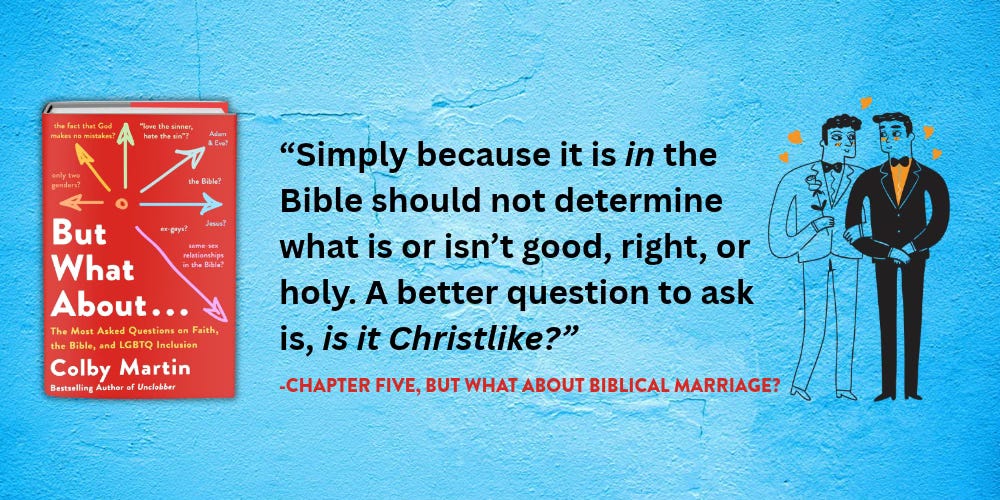
And third, all sorts of things are found in the Bible and could therefore reasonably be described as “biblical.” Simply because it is in the Bible should not determine what is or isn’t good, right, or holy. A better question to ask is, is it Christlike? For example, both genocide and loving your enemy are biblical, but only one is Christlike. Both retributive violence and grace-filled restoration are biblical, but only one is Christlike. Segregation? Biblical. Unity? Christlike.
So as we explore this idea of “biblical marriage,” I wonder if we might be better served by looking for what kinds of relationships (yes, including the marital kind) embody the way of Jesus.
A Christlike marriage seems far more important than whatever we might think it means to be biblical.
Marriage(s) in the Bible
I’m not convinced it makes sense to claim such a thing as “biblical marriage” even exists. Especially if that claim involves saying the Bible provides clear and specific instruction for what marriage is, how it should be enacted, and so on. When you search the Bible, you actually find all different kinds of “biblical” marriages.
Jacob and his two wives (Genesis 29-30);
Solomon and his hundreds of wives (1 Kings 11);
Ruth entering marriage via the Levirate marriage law (Ruth 4);
Instructions for when you defeat your enemies and see a beautiful woman, how you can take her and make her your wife as long as you shave her head and cut her nails (Deuteronomy 21:11);
Isaac and Rebekah’s arranged marriage (Genesis 24);
Joseph marrying Mary even though she’s already pregnant (Matthew 1:24-25)
To be fair, non-affirming Christians would push back and say that many of those are descriptive and not prescriptive (a point I’ll explore more in a minute). Meaning, the above examples tell us about those marriages, they don’t tell us to do those marriages. Except it’s not that clear cut, is it? The detailed instructions around the Levirate marriage, as well as the specific parameters for how to steal a bride from a defeated enemy sound pretty prescriptive to me. But sure, the other kinds of marriages should be read as descriptive not prescriptive. I’m not out here advocating for bringing back polygyny (men having multiple wives) or implementing arranged marriages.
What I’m hoping to show is that the Bible does not present a consistent, unified, or clear picture of what marriage is or has always been.
That being said, I do think we find ideas about the institution of marriage in the Bible that are worth naming. While no formal process is laid out for what marriage is or how marriages were legitimized, when viewed together as a whole I think we can make the following observations.
First, marriage in ancient Israel was similar to cultures of that time insofar as it being primarily a social and financial arrangement.
Second, marriages were the domain of the family and the community, not religion, priests, or the temple. Meaning there was nothing particularly religious about marriage in the Old Testament. Priests didn’t preside over ceremonies, the temple wasn’t reserved for day long celebrations, nor were there specific prayers or blessings spoken.
However, that does lead to a third observation, which is how marriage eventually became a metaphor prophets would use to illustrate the covenantal relationship between God and the Israelites. This reflects an evolution in thinking around marriage as it expanded beyond the practical components to now possess a sacred meaning.
Fourth, some parts of Scripture emphasize the importance of semi-sexual purity. I say “semi” because it mostly had to do with women. Women were expected to be virgins when given in marriage, and women were expected to only have sexual relations with their husbands. Men, however, had more liberty. For example, adultery was narrowly defined to prohibit a man from having sex with another woman who was married or betrothed. Which meant a man (married or not) could technically and legally have sex with another woman who wasn’t his wife as long as that woman wasn’t already the property of another man.
Observation number five is about passion and love. Like with other ancient civilizations, love was not a reason for marriage in the Old Testament, and yet we do have passages in Proverbs and Song of Solomon that clearly depict passion and sensuality in the marital context. While couples may not have married for love, that of course didn’t meant that they didn’t come to deeply love each other over time.
Finally, my sixth observation is about polygyny. On this matter the Old Testament is hard to pin down. While on the one hand it doesn’t offer direct prohibition against having multiple wives (see: Abraham, Jacob, David, and Solomon), and it even provides a context where polygyny might actually be commanded (see: Levirate marriage in Deuteronomy 25:5-10), it’s also reasonable from a narrative perspective to correlate polygyny with trouble. Mo’ spouses, mo’ problems.
At the end of the day I don’t think we can truthfully say there is a singular, clear definition for what biblical marriage is or is not. However, I do think it’s a worthy cause to try and describe what it would look like for a marriage to fulfill the reason for and the purpose of marriage as revealed in Scripture.
To show you what I mean, let’s now return to the passage from Genesis 2 and discuss the difference between something being prescriptive versus descriptive.

p.s. If you haven’t already, make sure to pre-order But What About on Amazon, Barnes & Noble, Target, Powells, or other options here.
p.p.s. If you missed it, I previously shared excerpts from
Chapter 2 (But What About the Bible?)
Chapter 3 (But What About Adam & Eve?)
Chapter 4 (But What About God not Making Mistakes with Gender?)
Book Launch Events in SAN DIEGO, PORTLAND, and DENVER
I’ve got three Book Signing & Launch events coming up. Hope to see you there!

San Diego | Nov 18 at 7:30pm
Warwick’s Books
RSVP Here
Portland | Dec 2 at 7pm
Powells City of Books
INFO Here
Denver | Dec 14 at 6pm
Tattered Cover
TICKETS Here
Thanks my dear brother! The only real marriage I find in Scripture is the Marriage of the Lamb in Revelation 19 where we do find the only four times in Scripture the word Alleluia! (In the psalms it is Praise ye the Lord! Even if some translate it alleluia). Every other marriage is a pale shadow of That One. I don't want to miss that one, whatever other marriage I may experience at present. Much love from Italy. Giuseppe