

I had a lot to learn while writing my first book.
For example, upon reading an early draft of one of my first chapters, a friend of mine sent me this.
He wasn’t wrong. My writing was, well, in need of help. (Thanks again, Derek :)
Another thing I learned came from my editor who kept using the word “scope.” Since the topic of the Bible and homosexuality could go in many different directions (directions I kept trying to take it during my first draft), my editor routinely reminded me of the scope of the book.
Just the six clobber passages, Colby. (Thanks again, Jessica :)
And so that’s what UnClobber did. Its scope was narrow, exploring only the material found in Genesis 19, Leviticus 18 & 22, Romans 1, 1 Corinthians 6, and 1 Timothy 1.
While that made for a compelling and clear book, it didn’t take long before learning there are other clobber-adjacent passages that many people wish I would’ve included.
Top of that list?
The story about Adam and Eve.
As I mentioned the other day, my next book, But What About: The Most Asked Questions on Faith, the Bible, and LGBTQ Inclusion seeks to continue building the case (the one I started in 2016 with UnClobber) that the LGBTQ affirming position is not a departure of our Christian faith but is, in fact, its truest expression.1
My approach in But What About was to compile the questions that have been most frequently asked at my live events and workshops, or sent through my website and DMs.
Questions asked by those who still aren’t convinced that all people are beloved children of God just as they are.
And one of those most asked questions is, But what about Adam and Eve?
So as I did with Chapter 2, I’d like to now offer you a glimpse into Chapter 3.
Enjoy.
-Colby
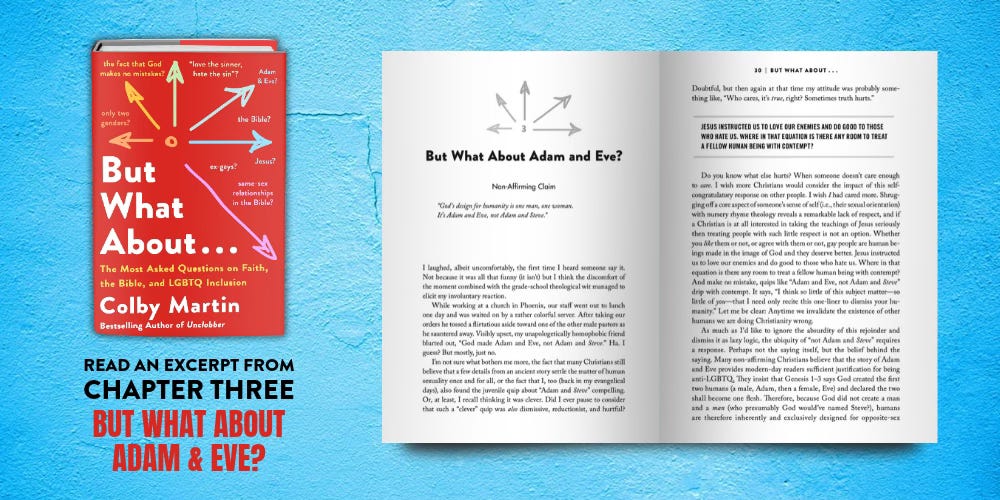
p.s. If you haven’t already, make sure to pre-order But What About on Amazon, Barnes & Noble, Target, Powells, or other options here.
CHAPTER 3
But What About Adam and Eve?
Non-Affirming Claim:
“God’s design for humanity is one man, one woman. It’s Adam and Eve, not Adam and Steve.”
I laughed, albeit uncomfortably, the first time I heard someone say it.
Not because it was all that funny (it isn’t) but I think the discomfort of the moment combined with the grade school theological wit managed to elicit my involuntary reaction.
While working at a church in Phoenix, our staff went out to lunch one day and was waited on by a rather colorful server. After taking our orders he tossed a flirtatious aside toward one of the other male pastors as he sauntered away. Visibly upset, my unapologetically homophobic friend blurted out, “God made Adam and Eve, not Adam and Steve.” Ha. I guess? But mostly, just no.
I’m not sure what bothers me more, the fact that many Christians still believe that a few details from an ancient story settle the matter of human sexuality once and for all, or, the fact that I too (back in my evangelical days) also found the juvenile quip about “Adam and Steve” compelling. Or at least, I recall thinking it was clever. Did I ever pause to consider that such a “clever” quip was also dismissive, reductionist, and hurtful? Doubtful, but then again at that time my attitude was probably something like, “Who cares, it was true, right? Sometimes truth hurts.”
Do you know what else hurts? When someone doesn’t care enough to care. I wish more Christians would consider the impact of this self-congratulatory clever response on other people. I wish I had cared more. Shrugging off a core aspect of someone’s sense of self (ie, their sexual orientation) with nursery rhyme theology reveals a remarkable lack of respect, and if a Christian is at all interested in taking the teachings of Jesus seriously then treating people with such little respect is not an option. Whether you like them or not, or agree with them or not, gay people are human beings made in the image of God and they deserve better. Jesus instructed us to love our enemies and do good to those who hate us. Where in that equation is there any room to treat a fellow human being with contempt? And make no mistake, quips like, “Adam and Eve, not Adam and Steve” drip with contempt. It says, “I think so little of this subject matter—so little of you—that I need only recite this one-liner to dismiss your humanity.” Let me be clear: Anytime we invalidate the existence of other humans we are doing Christianity wrong.
As much as I’d like to ignore the absurdity of this rejoinder and dismiss it as lazy logic, the ubiquity of “not Adam and Steve” requires a response. Perhaps not the saying itself, but the belief behind the saying. Many non-affirming Christians believe that the story of Adam and Eve provides modern day readers sufficient justification for being anti-LGBTQ. They insist that Genesis 1-3 says God created the first two humans (a male, Adam; then a female, Eve) and declared the two shall become one flesh. Therefore, because God did not create a man and a man (who presumably God would’ve named Steve?), humans are therefore inherently and exclusively designed for opposite sex relationships. When people say, “But what about Adam and Eve” as a rhetorical statement of the non-affirming position, they’re saying that any variation of one man + one woman is an aberration of God’s original plan.
But are they correct? Does the Creation story provide justification for saying God only blesses straight relationship? A proper understanding of what is (and is not) going on in the Creation story should dismantle any notion that either the orientation of homosexuality or same sex relationships are wrong, disordered, or sinful.
Neither Historical nor Literal
For years I read Old Testament stories—especially those in early Genesis—with about as much critical thought as a children’s book. Actually, I take that back. Reading the Creation account in Genesis 1-3 as though it were a children’s book would have been an improvement. After all, when you read a children’s book like, say, If You Give a Mouse a Cookie you understand that the talking animals in the story ought not be taken literally. We appreciate that such stories are meant to illustrate a larger point the author is attempting to convey. We know that regardless of how much mice like cookies and pigs like pancakes it doesn’t mean they’ve developed human level communicative capacities. Yet many grownups read the opening chapters of Genesis and go, “Hmmm, so all of humanity came from just two human beings who once talked with a snake? Cool. That tracks. No further questions.” Recently a friend told me about a Jewish commentary on Genesis which explained how the inclusion of the talking snake in the story was the signal for the original audience to know, oooh, this is a story! It’s not just that we shouldn’t read the story as literal, it’s that the story itself screams, “Don’t take me literally!” Perhaps if we titled Genesis 3, If You Give a Human an Apple, we’d have less misunderstandings.
Unfortunately, as it stands many Christians think the opening chapters of Genesis should be read literally and as historical fact. In other words, if there was an ancient fly on the wall tasked with hitting record on a Sony camcorder then we’d literally have footage of God creating Earth and the celestial bodies in four 24 hour days (Genesis 1:1-19); then filling the water and air with creatures on the fifth day (Genesis 1:20-23); and finally loading up the dry land with the animals on the sixth day. From there, if you pressed fast forward, you’d witness a conversation between Eve and a snake, followed by both humans eating the forbidden fruit, and ending with you crying on your couch as God expels them from a real garden named Eden.
Such a literal and historical view on Genesis accounts for a recent Gallup survey which revealed that 4 in 10 Americans believe in what is called Young Earth Creationism (YEC). This viewpoint maintains that the earth is approximately 10,000 years old, and that God created two fully formed humans (Adam and Eve) who then populated the entire planet. I don’t know who needs to hear this, but the evidence for the age of the universe is so overwhelmingly in favor of being really, really old—think billions of years, not thousands. Any claim to a Young Earth at this point is scientifically embarrassing. However, I would do well to keep some humility nearby, because this used to be how I thought. And when you’re raised with only one set of ideas to support one conclusion, you can only ever know what you know. That being said, the explosion of the information age via the internet has all but rendered such a siloed position obsolete. We just know too much now. There are no good scientific reasons to think our planet is 10,000 years old, but YECs don’t use science to arrive at a young Earth. They get there via a hyper literal reading of the Old Testament where they read genealogy lists like the one in Genesis 5, count the ages of humans from Noah back to Adam, and conclude that the planet’s Creation therefore happened only a few thousand years ago.
At this point, I think the only reason Christians believe in a Young Earth is because they choose to read Genesis literally, not because they have sufficient reasons or data to back it up. And they either choose to read the Bible literally because it’s all they’ve ever known (and mistakenly assume it’s how Christians have always read Scripture), or because they’ve been taught that not reading it literally is dangerous. One prominent Young Earth Creationist put it like this, “Christians who flirt with less-than-literal readings of biblical texts are also flirting with theological disaster.” I remember being raised with that mentality. You either believe God’s word all the way (and “believe” was always used to imply, “read the text literally”) or not at all. That kind of binary thinking is understandably scary. Who would dare risk questioning a six day creation story, or the historicity of Adam and Eve, if that meant we were simultaneously questioning the death and resurrection of Jesus?! This all-or-nothing mentality imprisons Christians in a trap of fear, but I’m telling you the trap has no lock. You can just… leave.
I know it’s frightening because we’ve probably never been told this (or worse, we’ve been taught to fear this), but there are many other ways a person can read and “believe” the Bible that don’t require a literal interpretation. You can absolutely still believe the Bible and not read it in a literal sense. Reading portions of Scripture in non-literal ways (be it allegory, metaphor, poetry, etc) is not a less-than approach, it’s actually taking the Bible more seriously. In fact, sometimes in order to rightly believe the Bible we must not read it literally. For instance, most Christians don’t think that men should literally gouge out their eye or cut off their hand if they lust after a woman because they understand Jesus was using hyperbole to make a point. In cases like this, interpreting the passage literally would actually be the “less-than” approach that fundamentalists warn about.
Speaking of taking the Bible seriously, and to aid us in our efforts to move away from a rigidly literal interpretation, did you know there are actually two Creation stories in Genesis?

Book Launch Events in SAN DIEGO, PORTLAND, and DENVER
I’ve got three Book Signing & Launch events coming up. Hope to see you there!

San Diego | Nov 18 at 7:30pm
Warwick’s Books
RSVP Here
Portland | Dec 2 at 7pm
Powells City of Books
INFO Here
Denver | Dec 14 at 6pm
Tattered Cover
TICKETS Here
This usage of “Not X but Y” construction is entirely my own and not the product of AI. Reminder: AI was trained on us, the writers. I was using em dashes and negative parallelism long before the LLMs tried sounding like us. I shan’t relinquish them easily.